Tune follows the slow centre.
Amount sets correction depth. Natural retains a share of the expressive movement around that centre, and low-confidence frames return to delayed dry.
The target is chromatic.
ONE VOCAL PATH · FOUR SCREENS · PRIVATE BETA
Chicken Vocals is one low-latency processor for the whole vocal path. Its four screens follow the signal from chromatic Tune to the last wash of reverb, with 10.0 ms selected for Tune latency and the dry vocal kept at the centre of Width.
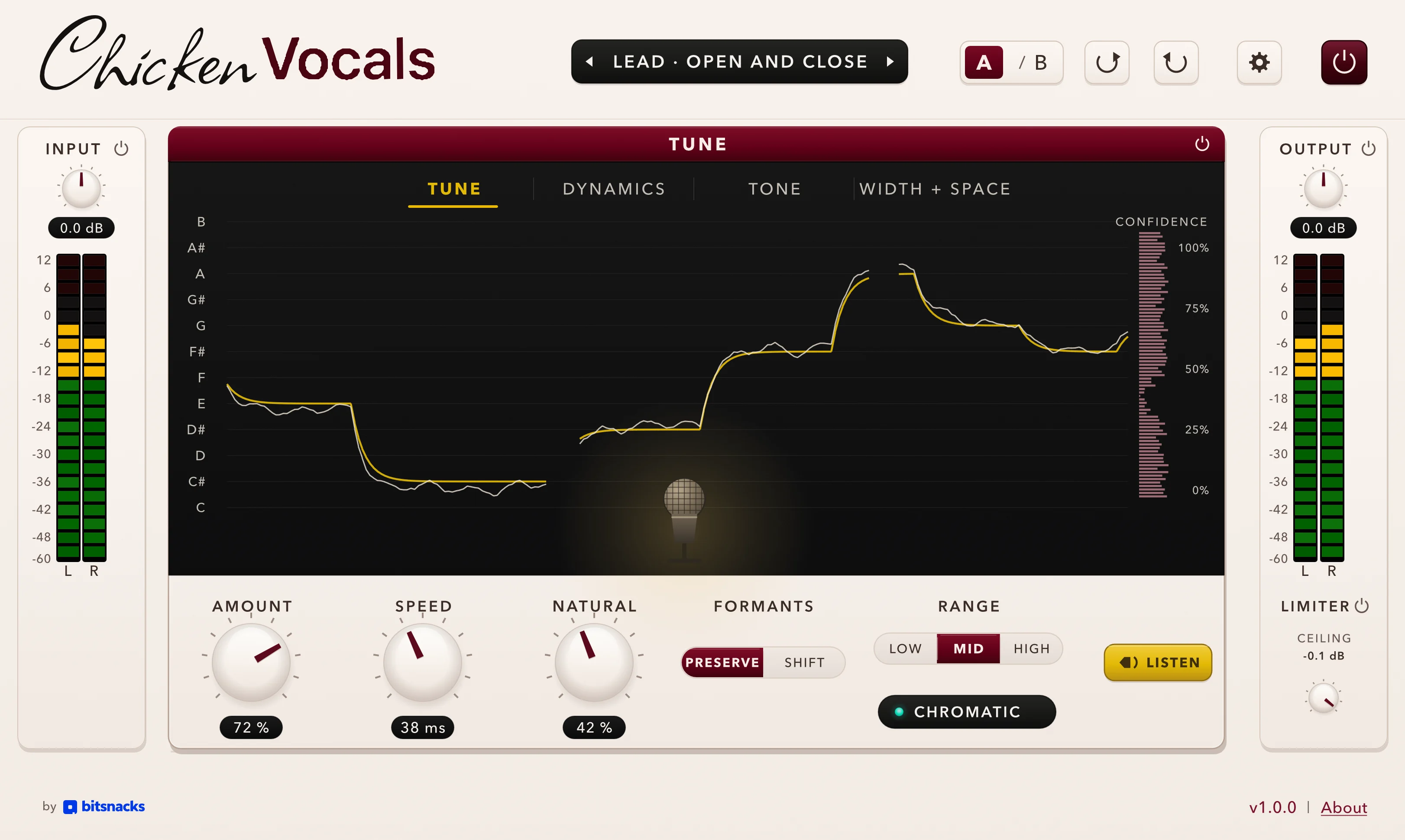
Amount sets correction depth. Speed follows the centre, while Natural retains expressive movement and Formants chooses Preserve or Shift.
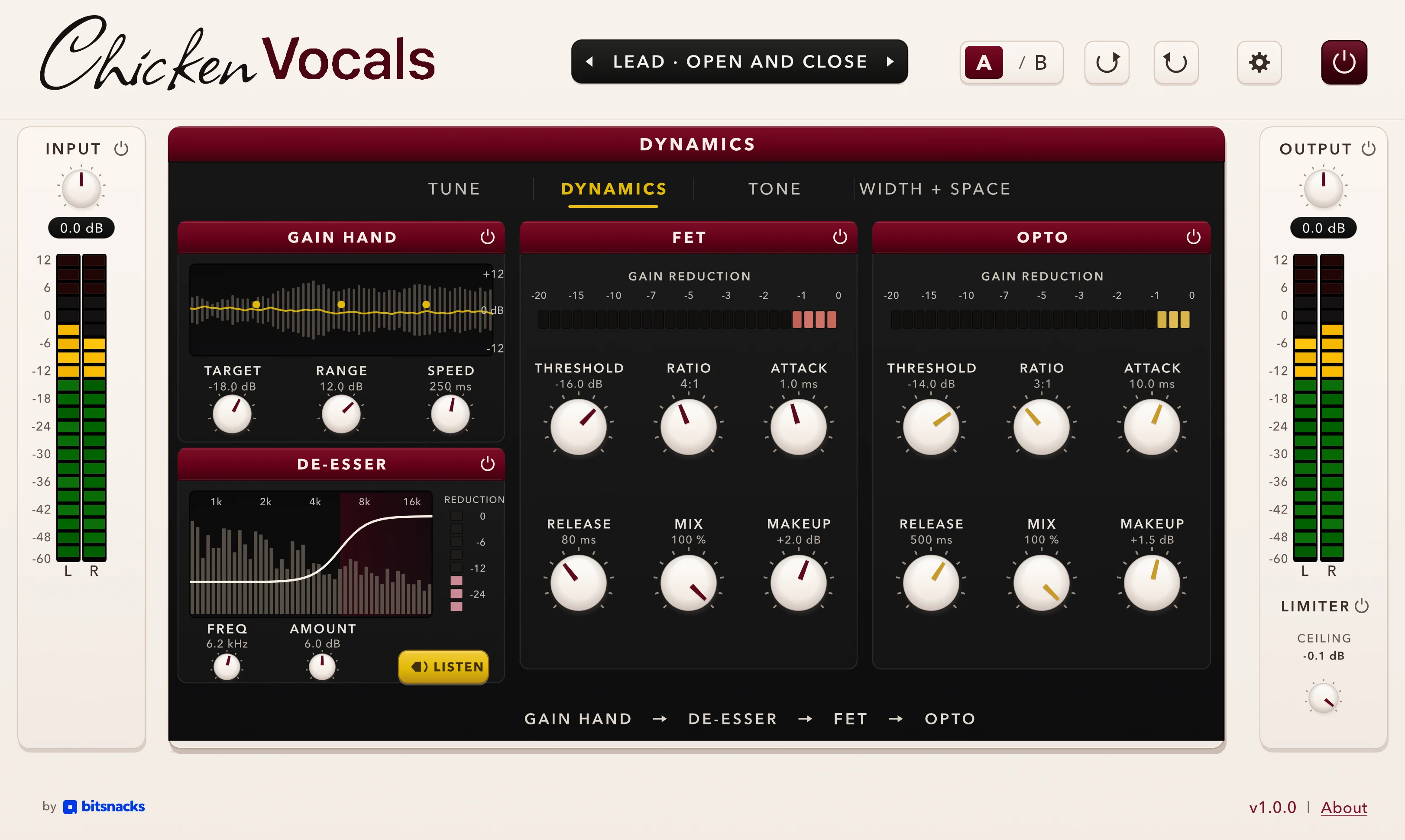
The De-Esser follows phrase levelling. FET catches fast peaks before Opto settles the longer movement.
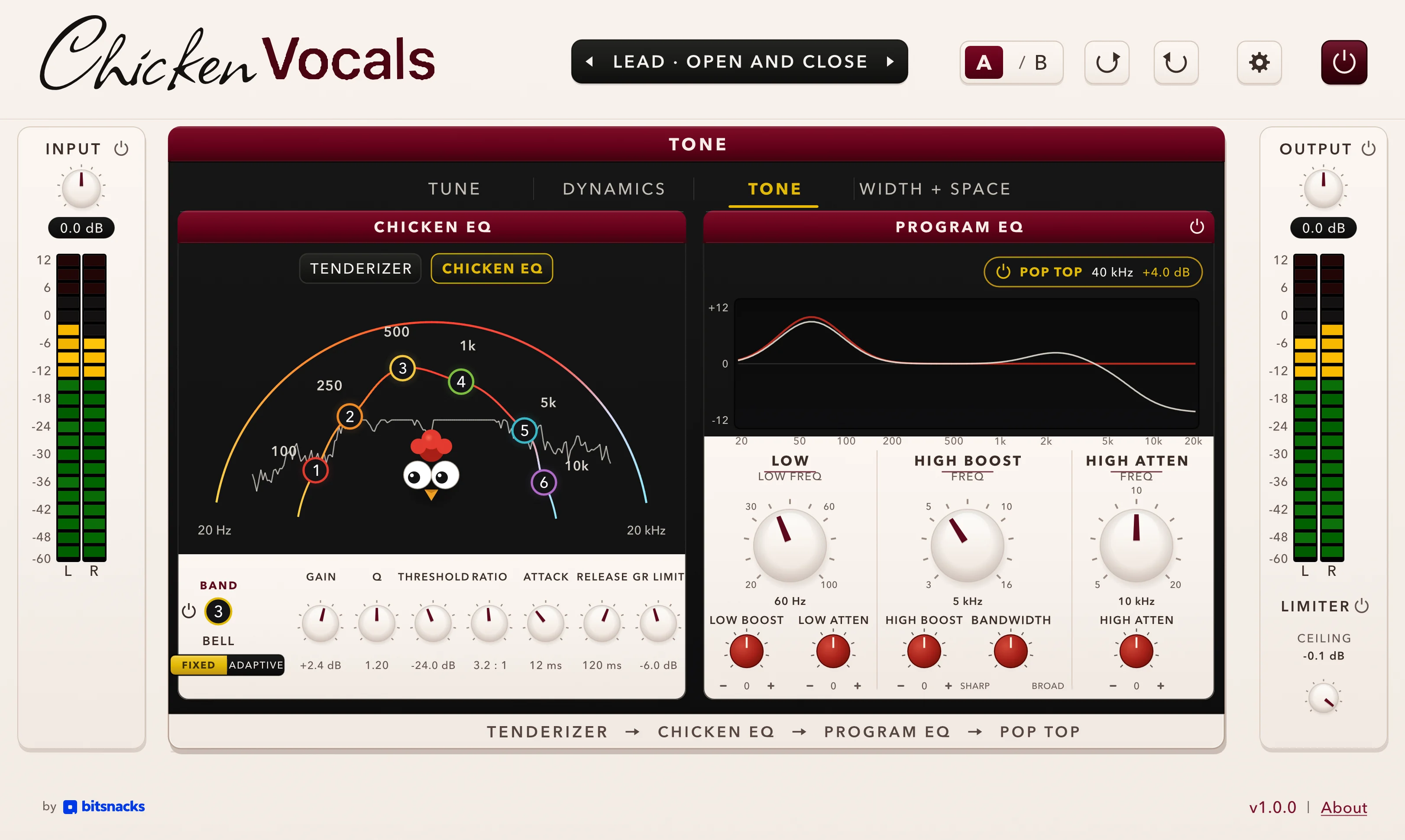
Tenderizer prepares the spectrum. Chicken EQ handles precise moves; Program EQ supplies broad curves, then Pop Top closes the chain.
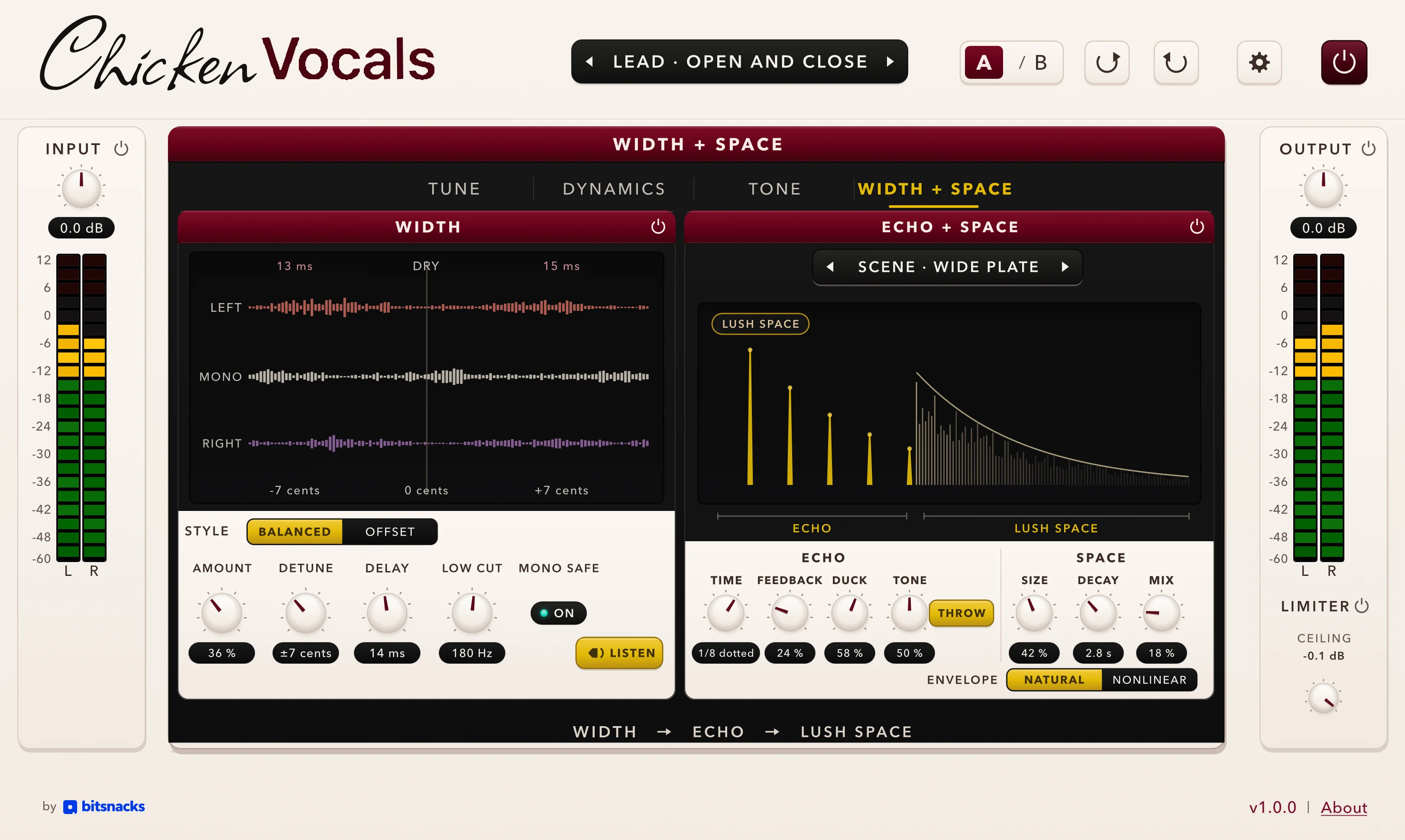
Generated side voices supply thickness. Echo ducks under direct words and feeds Lush Space.
The controls redraw this visual preview. It processes 0 browser audio samples. Chicken Vocals is in private beta.
WHAT THE STAGES ARE FOR
The order is fixed. Each stage receives the result of the previous one, so phrase levelling happens before peak control and the spatial effects come after tone.
Amount sets correction depth. Natural retains a share of the expressive movement around that centre, and low-confidence frames return to delayed dry.
The target is chromatic.
It rides long vocal level before the compressors.
Frequency sets the detector region.
Amount caps the requested reduction.
The fixed compressor pair gives the fast stage responsibility for peaks, then hands the result to a slower levelling stage whose timing and ratio remain independently controllable.
Tenderizer comes first.
Chicken EQ handles precise moves; Program EQ supplies the broader curve.
Pop Top finishes.
Width adds side voices without moving it.
Duck reduces the repeat under direct vocal energy.
Throw raises the send for an automatable moment.
Echo feeds the reverb in the printed signal order, and the wet envelope can stay Natural or switch to the defined Nonlinear shape while the dry path remains intact.
FOUR SCREENS
Changing screens affects visibility only. The selected screen never changes processing latency, parameter state or automation identity.
TUNE
Amount, Speed and Natural each have one job. Formants chooses Preserve or Shift, while Range limits detector candidates.
DYNAMICS
The De-Esser sits between them, after phrase levelling and before FET into Opto, because those processors solve different time-scale problems.
TONE
Tenderizer prepares the spectrum.
Chicken EQ and Program EQ remain complete modules.
Pop Top is last.
WIDTH + SPACE
Balanced or Offset side voices lead into ducked Echo, then Lush Space closes the 13-stage path.
PRODUCT DETAILS
Version 1 begins at Tune and ends after Lush Space plus Output Safety. Screen changes leave the route alone. State and automation remain attached to the same host controls.
THE COMPLETE PATH
CURRENT STATUS
Chicken Vocals brings its 4-screen workflow and fixed 13-stage signal path into one plug-in. Tune reports 10.0 ms at each of 6 supported sample rates.
Access is currently limited to the private beta.